How to Start Journaling When You Don’t Know What to Write

There’s something about a beautiful new notebook that makes you believe you’re about to become a slightly more organized, thoughtful version of yourself.
You buy it, admire it, perhaps even find the perfect pen to go with it. Then you open it, stare at the first page, and suddenly can’t think of a single thing worth writing.
Funny how we can have a hundred thoughts running through our minds while trying to fall asleep, yet the moment we’re given somewhere to put them, they all seem to disappear.
My first introduction to journaling was in high school, when we were required to keep a journal for one of our classes. Back then, it was simply another school assignment. I certainly didn’t think of it as something that might have value beyond the classroom.
But the older we get, the more appealing the idea of having a little space entirely to ourselves becomes. Somewhere to think things through, remember the good bits, question the not-so-good bits, and occasionally admit that we have absolutely no idea what we’re doing.
If you’ve been wondering how to start journaling but aren’t quite sure what to write, here’s a simple way to begin, along with 25 journaling prompts for those days when the words just won’t come.
1. Forget What You Think a Journal Should Look Like
Spend five minutes looking at journals on Pinterest and you could easily come away thinking journaling requires beautiful handwriting, watercolor illustrations, perfectly coordinated stickers, and an impressive collection of stationery.
Lovely to look at? Absolutely.
Necessary? Not remotely.
A journal can be messy, repetitive, funny, emotional, or wonderfully mundane. It can contain a shopping list on one page and a surprisingly deep thought on the next.
You might write about a conversation that stayed with you, a decision you’re struggling to make, or something as ordinary as how much you enjoyed having the house to yourself for an afternoon.
Not everything needs to have a deeper meaning.
The beauty of a journal is that it’s one of the few places where you don’t have to explain yourself to anyone.
2. Find a Type of Journaling That Feels Right for You
One reason people struggle to get started is that they assume journaling means sitting down and writing a detailed account of their day.
If that sounds about as appealing as writing a school essay, there are plenty of other ways to do it.
Traditional Journaling
Think of this as a conversation with yourself on paper.
Write about what’s happening in your life, how you feel about it, or whatever happens to be occupying your thoughts that day.
Some entries might be several pages long. Others might consist of three sentences and a rather emphatic exclamation mark.
Gratitude Journaling
A gratitude journal encourages you to notice the things that are going well, particularly the little things that tend to get lost in the busyness of everyday life.
It could be a phone call from someone you love, finding something you thought you’d lost, or getting through an entire day with nothing unexpectedly breaking in the house.
There is no need to search for something extraordinary. Ordinary pleasures deserve a little attention, too.
Brain Dump Journaling
This is probably the type of journaling I relate to most.
There are mornings when I wake up and, before my feet even touch the floor, my mind is already running through all the things I need to get done. Since I get distracted rather easily, I also worry that I’ll forget half of them as the day unfolds.
It’s a little like having twenty-seven browser tabs open and not knowing where the music is coming from.
I’ve found that simply writing everything down takes some of that weight off my shoulders. Nothing has actually been accomplished yet, but somehow, I already feel a little less stressed. I no longer have to keep reminding myself not to forget.
That’s essentially what brain dump journaling is all about.
Write down everything that’s occupying your mind: appointments, errands, unfinished tasks, worries, random ideas, things you need to remember, and decisions you’ve been postponing.
Don’t worry about organizing or prioritizing anything at this stage. The purpose is to clear some mental space.
Once everything is on paper, you can go through your notes, identify what needs immediate attention, create a realistic to-do list, and leave the less urgent things for another day.
Sometimes, it’s not the number of things we have to do that’s overwhelming. It’s the effort of trying to keep track of them all in our heads.
Guided Journaling
If the blank page is your biggest obstacle, a guided journal is a wonderful place to start.
Instead of having to come up with something to write about, you respond to a question that’s already there.
A thoughtful prompt can take you in an unexpected direction and encourage you to think about something you might otherwise have brushed aside.
Bullet Journaling
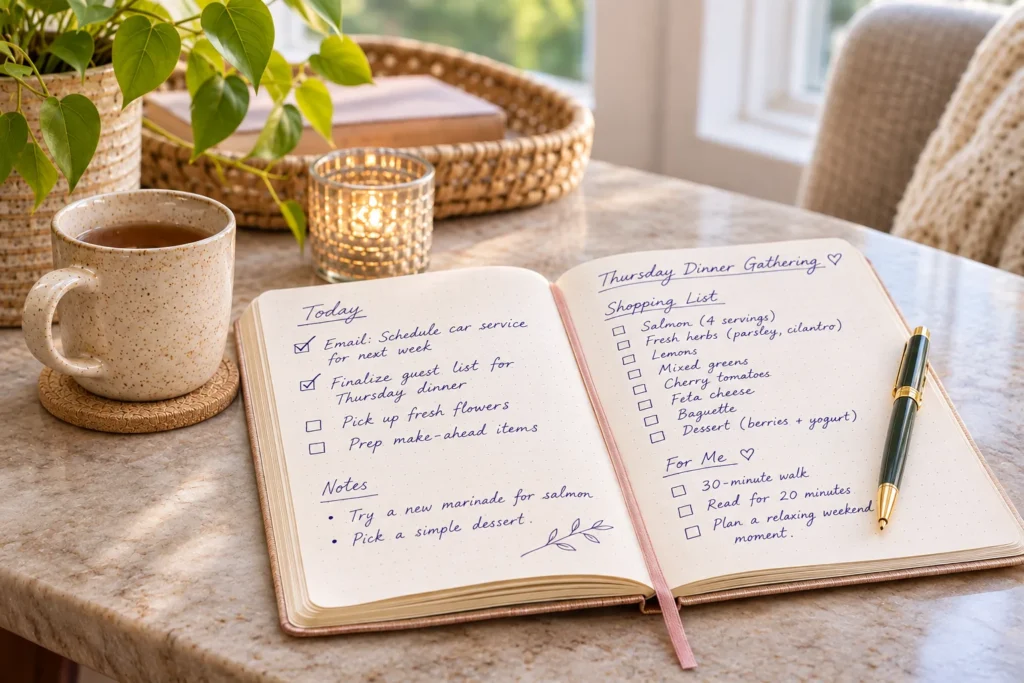
If you like the idea of a brain dump but prefer a little more structure, bullet journaling might be a better fit for you.
Rather than writing long paragraphs, you use short entries, bullet points, and simple symbols to keep track of tasks, appointments, reminders, goals, and ideas.
The appeal of this method is that it combines journaling with everyday planning. Instead of having reminders scattered across sticky notes, scraps of paper, and various apps on your phone, you can give them a home in one notebook.
Of course, if you’ve seen bullet journals on Pinterest, you might think you need artistic talent, beautiful handwriting, and an entire drawer of colored pens.
You really don’t.
The original Bullet Journal method was designed around organization and reflection, not decoration. A notebook, a pen, and a few simple symbols are enough to get started.
You can even combine the two approaches by starting with a brain dump and then transferring the tasks that require action into your bullet journal.
Memory Journaling
Have you ever come across an old photograph and wished you could remember more about the day it was taken?
A memory journal is a way of capturing those little details that photographs alone can’t tell us.
The funny thing someone said at dinner. The restaurant you stumbled upon during a trip. The recipe your mother always made but never measured properly.
These are the things that can become surprisingly precious over time.
You don’t have to choose just one journaling style, either. Your notebook can be a little bit of everything.
3. Start With What Is Already on Your Mind
You don’t need to wait until something interesting happens in your life to begin journaling.
In fact, the most useful starting point might be whatever you’ve been thinking about while folding laundry, driving to the grocery store, or lying awake at night.
Perhaps there’s something you’ve been putting off. Maybe you’re excited about a new idea but haven’t quite worked out what to do with it. Or perhaps you’ve simply been feeling a little restless lately and aren’t sure why.
Start there.
If you’re still struggling, try finishing one of these sentences:
- Lately, I’ve been thinking about…
- Something I wish I had more time for is…
- I don’t quite know how I feel about…
- One thing that surprised me today was…
- If I could change one thing about this week…
You might be surprised by where a single sentence takes you.
Here’s an example of what an ordinary journal entry might look like:
I’ve been busy all day, yet I can’t quite work out what I’ve accomplished. I seem to have spent most of my time dealing with little things that could probably have waited. Tomorrow, I’d like to finish something that actually matters to me before getting caught up in everything else.
Nothing particularly poetic about that. But it captures a thought, recognizes a pattern, and offers something to consider tomorrow.
And remember, this isn’t a school assignment. Nobody is going to correct your grammar, judge your thoughts, or tell you that you’ve written something wrong. Your journal is for your eyes only, so there’s no need to impress anyone or even make perfect sense.
A few honest sentences about an ordinary day are just as valuable as a page full of profound thoughts.
That’s a perfectly good journal entry.
4. Give Yourself Five Minutes, Not an Hour
There’s a tendency to turn every new interest into a whole new lifestyle.
We decide we’re going to get up earlier, make a lovely cup of tea, find a peaceful corner, light a candle, and spend half an hour reflecting before the day begins.
It sounds wonderful until real life intervenes.
Instead, give yourself five minutes.
Five minutes while you’re having your morning coffee. Five minutes before bed. Five minutes when you happen to have the house to yourself.
If you feel like continuing, carry on. If you’ve written everything you wanted to say after two minutes, close the notebook.
There is no prize for filling the most pages.
5. Keep These 25 Journaling Prompts Handy
Even when you’ve been journaling for a while, there will be days when you want to write but can’t quite find a starting point.
Having a few good questions to turn to makes all the difference.
I’ve grouped these journaling prompts into different categories so you can choose something that suits your mood rather than working through them in order.
Journaling Prompts for Everyday Reflection
- What was the nicest part of my day?
- What has been taking up most of my mental energy lately?
- What made me laugh recently?
- Is there something I wish I had handled differently today?
- What would make tomorrow a little easier?
Journaling Prompts for Self-Discovery
- What do I enjoy doing when nobody needs anything from me?
- What is something I’ve always wanted to try but never quite got around to?
- What matters more to me now than it did ten years ago?
- When do I feel most like myself?
- What is something about myself that I’ve learned to appreciate with age?
Journaling Prompts for Clearing Your Mind
- What am I putting off, and what’s really stopping me?
- What am I worrying about that is outside my control?
- Am I making something more complicated than it needs to be?
- What decision would I make if I weren’t worried about disappointing anyone?
- What could I take off my plate this week?
Journaling Prompts for Gratitude
- What small comfort would I miss if it were suddenly gone?
- Who has made my life better, perhaps in ways they don’t even realize?
- What ordinary moment from today would I like to remember?
- What do I have now that I once wished for?
- When was the last time I felt genuinely content?
Journaling Prompts for a New Chapter in Life
- What would I like the next few years of my life to look like?
- What am I still holding on to that no longer serves me?
- What does a fulfilling day look like to me now?
- What would I try if I didn’t feel the need to be good at it?
- If I had a little more courage, what would I do differently?
Some of these questions might take you a few seconds to answer. Others might stay with you for days.
You can even return to the same question months later and see whether your answer has changed. Sometimes, that’s where things get really interesting.
6. Make Journaling Something You Look Forward To
A little atmosphere never hurts.
If you enjoy sitting somewhere comfortable with a cup of coffee, a favorite pen, and a lovely notebook, by all means make that part of the experience.
But don’t make the perfect setting a condition for writing.
Keep your journal somewhere you’re likely to see it. Beside your bed, on your desk, or wherever you tend to sit when you have a quiet moment.
If you prefer a little structure, choose a regular time to write. If you dislike routines, keep your notebook handy and write whenever the mood strikes.
And if you miss a few days, don’t feel compelled to produce a detailed account of everything that’s happened since your last entry.
Your journal isn’t expecting an explanation for your absence.
Simply turn the page and carry on.
A calm, comfortable space can also make it easier to slow down and gather your thoughts. If your surroundings feel a little overwhelming, I’ve shared some simple ideas on how to make your home feel calmer without buying anything new.
7. A Few Journaling Essentials That Are Actually Worth Having

One of the nicest things about journaling is how little you need to get started. Chances are you already have everything required somewhere in your house.
That said, if you’re choosing a new journal, there are a few practical details worth paying attention to.
A Notebook That Lies Flat
It may seem like a small detail, but having to hold a notebook open with one hand while trying to write with the other gets irritating rather quickly.
A lay-flat journal is particularly comfortable for longer writing sessions. Choose lined pages for traditional journaling or dotted pages if you prefer lists, flexible layouts, and bullet journaling.
If you’re looking for a reasonably priced notebook, the PAPERAGE hardcover journal is a nice option. It has thicker ivory pages, a lay-flat design, a ribbon bookmark, and a handy little pocket at the back for loose notes and reminders. It also comes in a lovely selection of colors.
A Guided Journal for a Little Inspiration
If you’re drawn to journaling but regularly find yourself wondering what to write, a guided journal can take away that initial hesitation.
Look for one with thoughtful, varied questions rather than a rigid format that feels like another daily obligation.
The questions should make you curious, not leave you feeling as though you’ve been assigned homework.
If you’d prefer a little direction, the SOULVIA Guided Journal for Self-Discovery offers 180 prompts covering everything from gratitude and personal growth to finding a sense of purpose. What particularly appeals to me is that it’s undated, so you can skip a few days or even a few weeks and pick up right where you left off.
Pens That Are Comfortable to Write With
A pen that skips, smudges, or requires too much pressure can take some of the pleasure out of handwriting.
A smooth-writing pen with a comfortable grip is worth considering, especially if you tend to write for more than a few minutes at a time.
If you enjoy using different colors, a small selection can also help you separate ideas, highlight thoughts you want to revisit, or simply make your pages a little more cheerful.
Start with the basics. You can always add more later, once you know what kind of journaling you enjoy.
8. Don’t Let Journaling Become Another Thing You’re Supposed to Be Good At
By the time we reach a certain stage in life, most of us have spent years trying to meet expectations.
We’ve had responsibilities, deadlines, people depending on us, and seemingly endless lists of things we should be doing better.
Surely we can allow ourselves one activity that doesn’t require a performance review.
Your journal doesn’t need to be consistent, productive, inspirational, or even particularly well written.
You can have days when you’re grateful for everything and days when you’re irritated by practically everything. You can write about the same problem more than once. You can change your mind.
You can also leave difficult subjects alone if writing about them feels overwhelming. There is no obligation to explore every uncomfortable thought, and journaling is not a substitute for professional support when you need it.
Above all, don’t judge your own journal by what other people choose to share online.
What makes it valuable is that it’s yours.
Frequently Asked Questions About Journaling
What should a beginner write in a journal?
Begin with something familiar: what happened today, what you’re looking forward to, or what’s been on your mind. If you’re struggling to get started, choose one of the journaling prompts above and write whatever comes to you.
Do I need to journal every day?
Not at all. Some people enjoy writing daily, while others prefer a weekly reflection or write whenever something meaningful happens. Choose a frequency that feels comfortable.
Is it better to journal in the morning or at night?
Morning journaling can help you think about the day ahead, while evening journaling gives you an opportunity to reflect on what has happened. Neither is inherently better. It depends on what you want from the experience.
Can I journal on my phone instead of using a notebook?
Of course. A digital journal can be especially convenient if you prefer typing or want to capture thoughts while you’re out and about. If privacy is important to you, consider using a password-protected app.
What if I have nothing interesting to write about?
Write about something ordinary. What you noticed on your walk, what you enjoyed about your lunch, or a thought that crossed your mind while doing the dishes. A journal is a record of your life, not a collection of its greatest achievements.
The Ordinary Days Are Worth Remembering, Too
We tend to remember the big milestones in our lives. Birthdays, weddings, graduations, new homes, and important beginnings.
But so much of who we are exists in the days in between.
The conversations over coffee, the little discoveries, the things that made us laugh, the interests we developed, and the quiet moments when we realized our priorities had changed.
These are the details that can so easily slip away.
Perhaps that’s one of the loveliest reasons to keep a journal. Not because every day is extraordinary, but because even an ordinary day can contain something worth keeping.
So open that notebook you’ve been saving for something special.
Today’s as good a day as any.