No Pantry? 12 Clever Ways to Store Food in a Small Kitchen
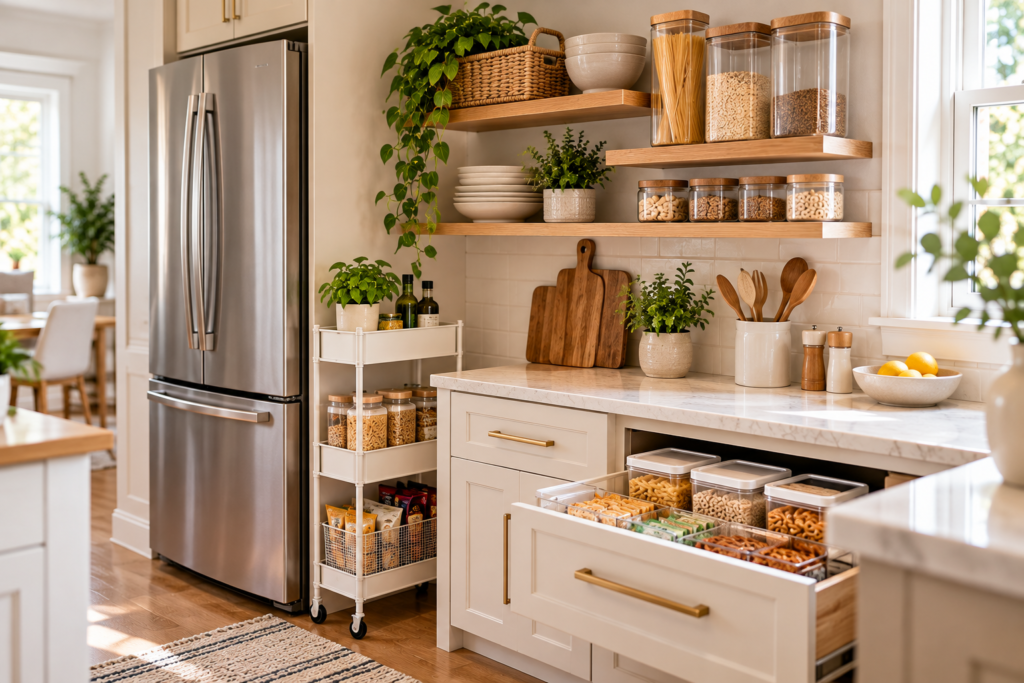
No pantry storage ideas can make a surprisingly big difference when your kitchen has limited cabinets, crowded countertops, and absolutely nowhere sensible to put the groceries.
Because apparently, kitchens are expected to hold pots, pans, dishes, appliances, cleaning supplies, and an entire week’s worth of food — whether there’s a pantry or not.
And when there isn’t one, things get creative. Pasta ends up behind the mixing bowls. Snacks take over a drawer. Three half-used bags of rice somehow occupy three different cabinets.
The good news? You don’t need to remodel your kitchen or squeeze in an expensive pantry cabinet.
You need a few smart places to store food, a better way to use the space you already have, and a system that doesn’t require reorganizing everything every Sunday.
Here are 12 practical ways to make that happen.
Disclosure: This post contains affiliate links. As an Amazon Associate I earn from qualifying purchases, at no extra cost to you.
1. Turn One Kitchen Cabinet Into a Mini Pantry
You don’t need an entire pantry. Sometimes one well-organized cabinet is enough.
Choose a cabinet that’s easy to reach and preferably close to where you prepare food. Remove anything that doesn’t need to live there, then group your groceries into categories.
Keep breakfast foods together, baking ingredients in one area, and snacks in another.
The goal isn’t to make the cabinet look like a grocery store display. It’s to stop searching three different places every time you need something.
A helpful storage option: Clear stackable pantry drawers make it easier to organize snacks, small food packages, and everyday pantry staples inside a regular kitchen cabinet. The pull-out design lets you reach items at the back without taking everything off the shelf.
Avoid buying bins until you’ve measured your cabinet. A container that looks perfect online is considerably less charming when it prevents the door from closing.
2. Use Cabinet Shelf Risers to Create Extra Storage
One of the most overlooked spaces in a kitchen is the empty air above everything sitting on a cabinet shelf.
You might have canned goods on the bottom and a completely unused six inches above them.
A shelf riser creates another level without requiring new cabinetry.
Use one to separate canned foods from lighter packaged goods, or to keep everyday ingredients visible.
A simple way to add more storage: Expandable cabinet shelf risers let you use the empty space above your groceries without installing additional shelves. They’re especially helpful for organizing canned foods, jars, and smaller pantry items in cabinets with unused vertical space.
Choose a sturdy, appropriately sized riser and keep heavier items on the original shelf below.
3. Add a Slim Rolling Cart to an Awkward Gap
That narrow space beside the refrigerator or between cabinets might be more useful than you think.
A slim rolling cart can hold packaged snacks, unopened pantry staples, or lightweight kitchen supplies.
The best part is that you can pull it out when you need something and tuck it away afterward.
A practical option for narrow spaces: A slim rolling kitchen cart can turn an awkward gap into useful storage for packaged foods, snacks, and everyday kitchen essentials. A four-tier metal design with wheels makes it easy to access everything, while a wooden top gives it a more finished look.
Before ordering, measure the gap in three places: top, middle, and bottom. Also check that the cart can roll out without hitting a refrigerator door or cabinet handle.
And remember that some gaps are needed for appliance ventilation. Don’t block the clearance required by your refrigerator’s manufacturer.
4. Make Better Use of Deep Kitchen Cabinets
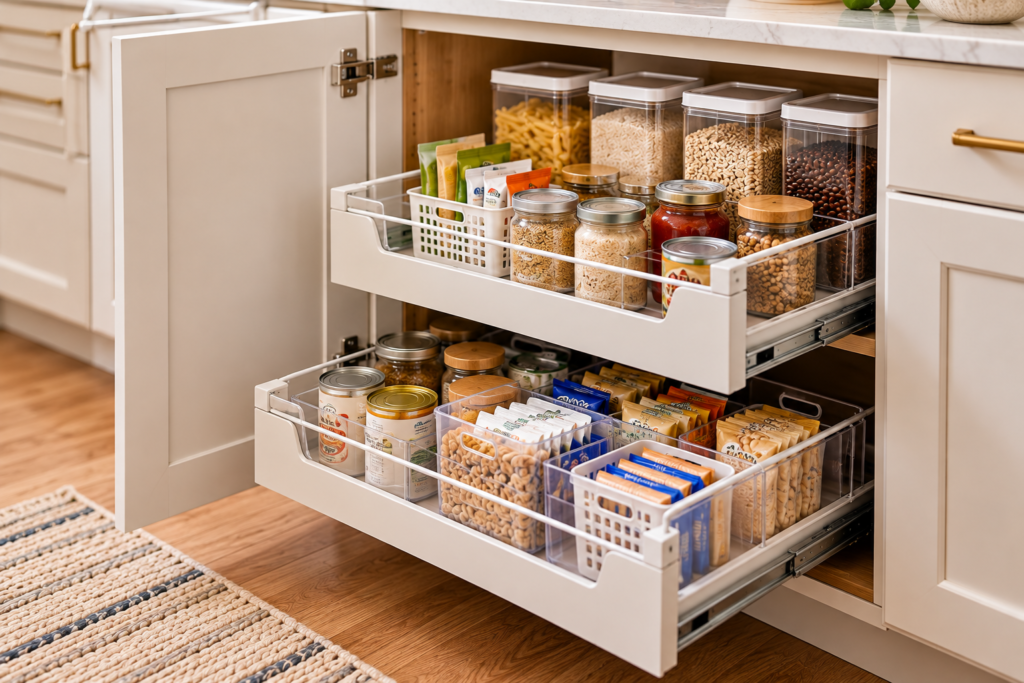
Deep cabinets sound wonderful until you realize that everything at the back becomes invisible.
You put something away, forget it exists, and buy another one.
Instead of stacking groceries in rows that disappear into the darkness, use pull-out bins or baskets.
That way, you can bring the contents forward instead of unloading half the cabinet.
For deep cabinets, an expandable pull-out organizer can make a big difference. Instead of reaching past everything at the front, you can slide the shelf forward and see what’s stored at the back. Adjustable-width designs are especially useful for fitting different cabinet sizes, but check the interior measurements and installation requirements before ordering.
Look for a design that fits your cabinet’s internal dimensions and can support the weight of the food you plan to store.
For renters, removable bins may be more practical than organizers that require screws.
5. Use the Inside of Cabinet Doors
Cabinet doors are valuable storage space that often goes completely unused.
A shallow organizer can hold spice packets, tea bags, small seasoning containers, or other lightweight items.
It’s especially useful when your shelves are already full.
Just make sure the organizer doesn’t collide with the shelves when the door closes. Check the cabinet’s hinges and the manufacturer’s weight limits before installing anything.
A door organizer should make the kitchen easier to use, not turn closing a cabinet into a negotiation.
6. Use Drawers for Packaged Foods and Snacks
Who decided kitchen drawers should only contain utensils?
A deep drawer can be a wonderful place for granola bars, crackers, snack packets, tea, and other packaged foods.
Instead of piling everything together, use adjustable dividers or a few small containers.
Keep frequently used items near the front and less-used packages toward the back.
This works particularly well for families because everyone can see what’s available without rummaging through several cabinets.
One practical rule: keep snacks away from heat sources, and follow the storage instructions on the packaging.
7. Use a Lazy Susan for Small Pantry Items
Some ingredients have a remarkable ability to hide behind each other.
Honey, peanut butter, vinegar, sauces, and small jars are frequent offenders.
A turntable solves the problem by letting you rotate everything into view.
You can use one in a cabinet, on a suitable shelf, or in a deep corner that’s difficult to reach.
Choose a size that turns freely without knocking into cabinet walls or other items.
And don’t overcrowd it. If you have to hold three bottles in place every time you spin it, the system isn’t helping.
8. Use Clear Containers for Foods You Buy Regularly
Clear food containers can make a small kitchen feel more organized, but there’s no reason to transfer every grocery item into a matching jar.
Start with the foods you buy and use regularly, such as:
- Rice and pasta
- Oats and cereal
- Flour and sugar
- Dry beans and lentils
Choose food-safe containers with suitable seals and openings wide enough to scoop or pour comfortably.
[Insert Affiliate Link: Airtight Food Storage Container Set]
A useful tip: keep the original packaging information or label the container with the food name, expiration or best-by date, and any cooking instructions you’ll need.
That matters especially when two similar-looking ingredients require different preparation.
And if you’re using the original packaging without any trouble, there’s no need to replace it just for appearance.
9. Create a Small Breakfast or Coffee Station
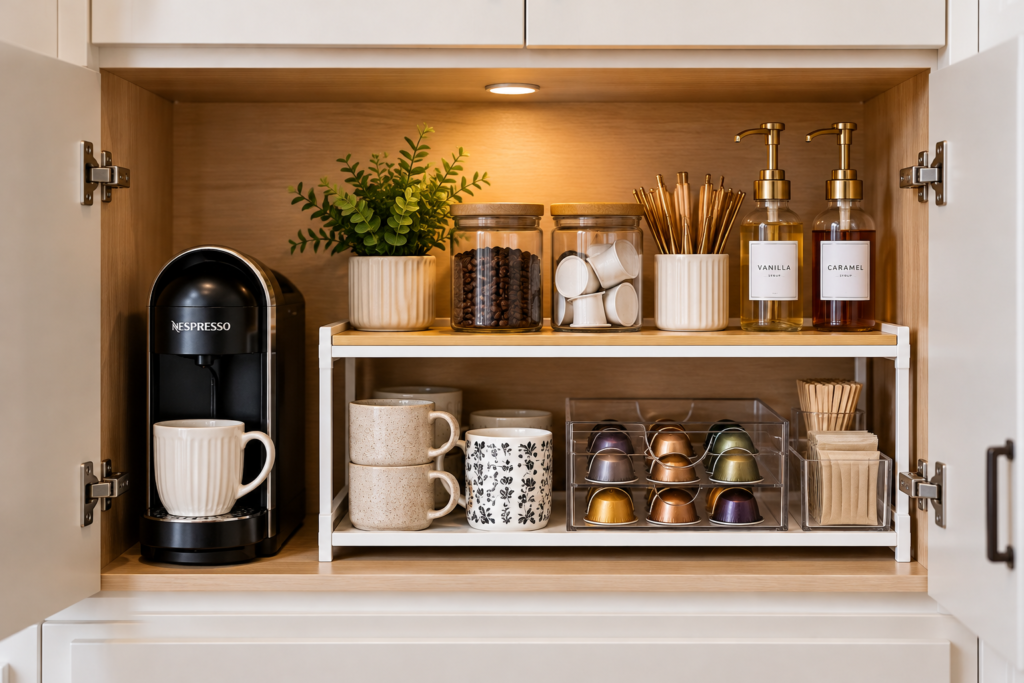
If breakfast supplies are scattered across the kitchen, bringing them together can save time every morning.
Designate one cabinet shelf, drawer, or small section of the counter for everyday breakfast items.
Keep coffee, tea, cereal, oatmeal, and other frequently used products nearby, depending on what your household actually eats.
A compact basket or divided organizer can keep everything together.
The trick is to give the station boundaries.
Otherwise, your tidy little coffee corner may eventually expand into a second pantry on the countertop.
10. Use Vertical Space With a Freestanding Shelf
If your kitchen has an unused wall or corner, a narrow freestanding shelving unit can provide meaningful extra storage.
It doesn’t have to be a large piece of furniture.
A compact shelf can hold lightweight pantry items, baskets, and a few everyday kitchen essentials.
For an open shelf, use matching or coordinating baskets only where they genuinely help contain smaller items. Not everything needs to be hidden.
Keep heavier items on lower shelves, respect the manufacturer’s load limits, and anchor furniture where required to reduce tip-over risk.
11. Store Bulk Purchases Outside the Kitchen
Not every grocery item needs to live in the kitchen.
If you buy extra unopened pasta, rice, cereal, or canned goods, consider keeping the overflow in another suitable storage area.
A nearby hallway closet or utility cabinet may work, provided it stays cool, dry, clean, and appropriate for food storage.
Use one clearly labeled container for overflow supplies.
The important part is to keep a manageable quantity and check what you already have before shopping.
Otherwise, your backup groceries can quietly become a collection of forgotten purchases.
12. Keep Less Food in Your Everyday Storage Space
This may be the most useful no-pantry storage idea of all, and it doesn’t require buying anything.
Sometimes the problem isn’t the size of the kitchen. It’s how much we’re asking it to hold.
Take a look at the groceries currently occupying your cabinets.
Are there specialty ingredients you bought for one recipe two years ago? Multiple opened packages of the same food? Bulk purchases that never seem to get used?
Check expiration dates and food condition, then discard anything unsafe or no longer usable.
For foods you intend to keep, put older packages toward the front so they’re easier to use first.
A smaller, more manageable food supply can make your existing cabinets feel considerably more spacious.
And it may help you spend less at the grocery store because you can finally see what you own.
Budget-Friendly No Pantry Storage Ideas That Actually Work
You don’t need to purchase twelve different organizers to make these ideas work.
In fact, buying too many storage products before figuring out the problem can leave you with less usable space.
Start with this simple approach:
- Empty one cabinet or drawer that’s giving you trouble.
- Group similar foods together and remove anything that doesn’t belong.
- Decide whether the problem is visibility, wasted vertical space, or difficult access.
- Reuse containers and baskets you already own before buying anything.
- Purchase one organizer only if it solves a specific problem.
For example, if you can’t see what’s at the back of a deep cabinet, a pull-out bin might help more than a set of beautiful jars.
If your shelves have plenty of unused height, a shelf riser may be all you need.
And if the kitchen simply holds too many groceries, no organizer will completely solve that.
The best storage system is one that fits the way you actually cook and shop.
A Small Kitchen Doesn’t Need a Perfect Pantry
It’s easy to look at beautiful pantry photos and feel that your own kitchen is missing something.
But an organized kitchen isn’t defined by matching containers, perfectly labeled shelves, or an entire room devoted to snacks.
It’s defined by being able to find what you need, put groceries away without rearranging everything, and prepare a meal without fighting your cabinets.
A drawer that holds your snacks neatly is doing its job. So is a basket that keeps pasta packages together or a shelf that makes your breakfast supplies easier to reach.
Start with one frustrating spot, fix that, and move on to the next.
You might discover that you don’t need a pantry nearly as much as you thought.
And if you’re dealing with limited storage elsewhere in your home, you might also enjoy No Linen Closet? 10 Smart Places to Store Towels, Sheets and Blankets — another practical guide to making the most of the space you already have.