No Linen Closet? 10 Smart Places to Store Towels, Sheets and Blankets
If you’re wondering how to store linens without a linen closet, the answer may be easier than trying to find one place big enough to hold everything.
Towels end up squeezed into bathroom cabinets. Extra sheets migrate from one bedroom to another. And bulky blankets somehow manage to take over half a closet.
But a linen closet isn’t actually necessary. Instead of trying to recreate one somewhere else, it often makes more sense to store things close to where they’re used.
Towels can stay near the bathroom. Sheets can live in the bedrooms. Extra blankets can go somewhere less accessible because you probably aren’t reaching for them every day.
Here are 10 practical ways to make that work.
Disclosure: This post contains affiliate links. As an Amazon Associate I earn from qualifying purchases, at no extra cost to you.
How to Store Linens Without a Linen Closet
1. Use the Space Under the Bed
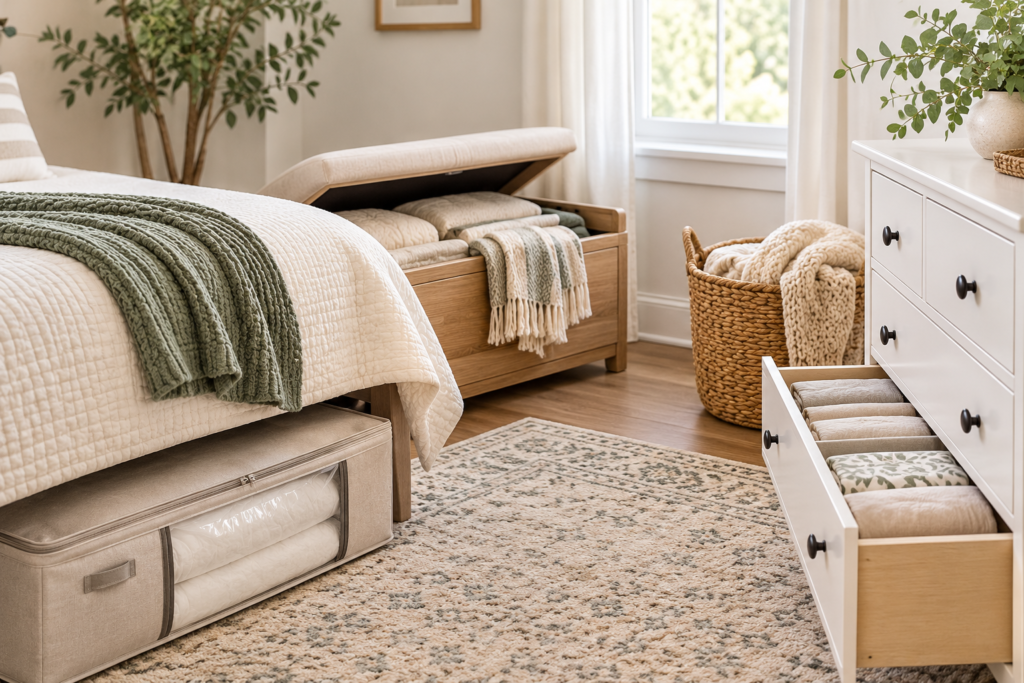
Under the bed is one of the most useful storage areas in a home, especially for extra sheets and blankets.
Instead of filling it with things you’ll forget are there, give the space a specific job. A low under-bed storage container can hold an extra set of sheets, guest bedding or seasonal blankets without taking up closet space.
Look for containers that zip or close completely rather than open baskets. Bedding stored near the floor will collect dust surprisingly quickly.
A covered under-bed storage container with wheels makes it easier to store extra sheets, guest bedding or seasonal blankets while keeping them protected from dust—and you can pull it out without dragging a heavy bin across the floor.
A good place for: extra sheets, guest bedding and seasonal blankets.
2. Keep Towels in the Bathroom
Towels don’t need to live with the sheets.
If there’s room in the bathroom, storing towels where they’re actually used is usually more convenient anyway.
A vanity cabinet, open shelf, wall cabinet or basket can all work. If you’re short on floor space, look upward. The area above the toilet or an unused section of wall can sometimes provide enough storage for several folded towels.
Just avoid squeezing too many towels into a damp, poorly ventilated cabinet. They need a little breathing room.
A good place for: bath towels, hand towels and washcloths.
3. Use the Back of a Door
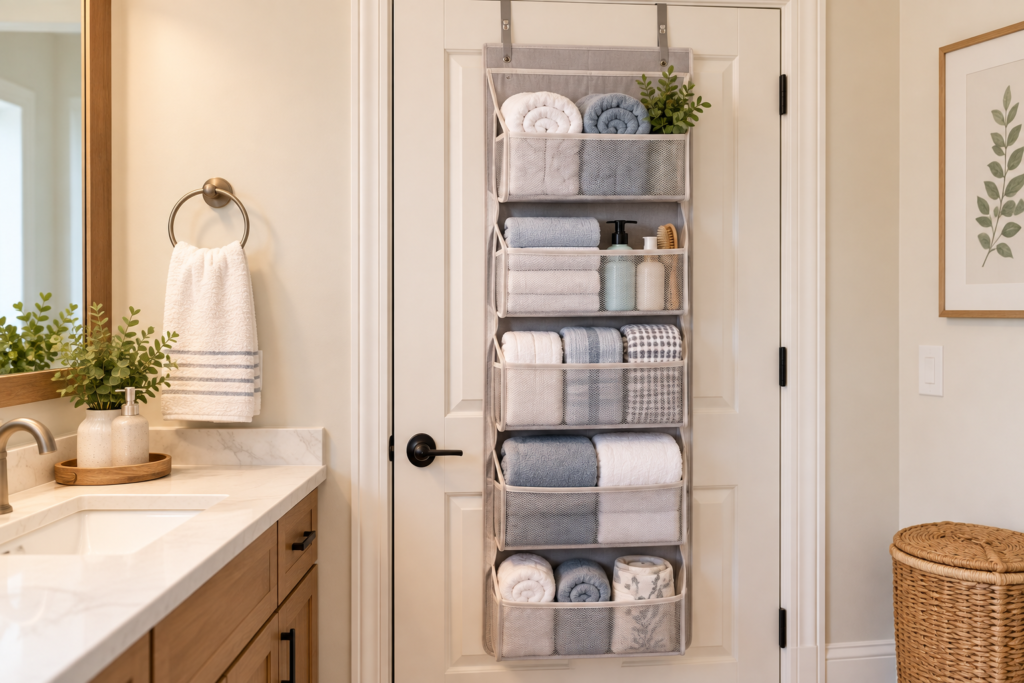
The back of a bathroom or closet door is easy to overlook, but it can provide useful storage without taking away any floor space.
An over-the-door organizer can hold rolled towels, washcloths, pillowcases or even small toiletries.
This works particularly well in apartments and smaller homes because it uses space that would otherwise do absolutely nothing.
For a little more storage, an over-the-door organizer with deep shelves or pockets can hold towels, washcloths and smaller bathroom essentials without using any floor space.
A good place for: towels, washcloths and smaller linens.
4. Turn One Closet Shelf Into a Mini Linen Closet
You don’t need an entire closet.
One shelf in a bedroom, hallway or guest-room closet can be enough if it’s organized intentionally.
The problem usually starts when stacks of sheets and towels slowly collapse into each other. Shelf dividers can keep separate piles upright so pulling out one set doesn’t bring everything else with it.
Give each section a job—sheets in one, pillowcases in another, towels somewhere else—and resist filling every available inch.
A good place for: everyday sheets, pillowcases and extra towels.
5. Store Sheets in the Bedroom Where They’re Used
This is one of the simplest solutions and doesn’t require buying anything.
Instead of keeping every sheet set together in one central location, store each set in the bedroom where it belongs.
A dresser drawer, closet shelf or under-bed container works perfectly well.
There’s also an easy way to keep sets together: fold the fitted sheet, flat sheet and one pillowcase, then tuck everything inside the remaining pillowcase. When it’s time to change the bed, the whole set is together.
No hunting for the matching pillowcase.
A good place for: everyday sheet sets.
6. Use Baskets When Storage Has to Stay Visible
Not everything has to disappear behind a closet door.
A good-looking basket can hold extra blankets or rolled towels while still looking intentional in a bedroom, bathroom or living room.
The important part is choosing what goes into it. A basket filled with two folded throws looks like storage. A basket stuffed with twelve unrelated things quickly becomes another clutter pile.
Visible storage works best when it has one clear purpose.
A good place for: throws, extra blankets and rolled towels.
7. Compress Bulky Blankets You Don’t Use Often
Comforters and heavy blankets are storage hogs.
If you only use them during colder months or when guests visit, they don’t need prime closet space all year.
Vacuum storage bags can dramatically reduce the amount of room bulky bedding takes up and make it easier to slide underneath a bed or place on a high closet shelf.
I wouldn’t use them for everything. Everyday bedding should remain easy to grab. They’re much more useful for items that might sit untouched for several months.
For bulky comforters and seasonal blankets, vacuum storage bags can shrink everything down considerably and make it much easier to fit on a high shelf or underneath a bed.
A good place for: comforters, seasonal blankets and guest bedding.
8. Claim the Top Shelf of a Closet
The highest shelf in a closet often becomes a parking spot for things nobody knows what to do with.
That’s valuable space.
Use it for linens you don’t need every week—guest towels, extra pillows or seasonal bedding.
Keeping less-used items higher up also leaves the easiest-to-reach shelves available for things you use regularly.
If the shelf is deep, avoid pushing loose linens all the way to the back. A labeled bin or storage bag makes it much easier to pull everything down without creating an avalanche.
A good place for: guest linens, spare pillows and seasonal bedding.
9. Let Furniture Do Double Duty
If storage is genuinely tight, the best solution may be furniture that earns the space it occupies.
A storage bench at the end of a bed can hold blankets and extra pillows. An ottoman with hidden storage can do the same thing in a living room.
This doesn’t mean replacing perfectly good furniture just to create linen storage. But if you’re already shopping for a bench or ottoman, choosing one with storage gives you useful space without adding another cabinet to the room.
A good place for: blankets, throws and extra pillows.
10. Keep Fewer Linens
This one isn’t as exciting as buying organizers, but it can make the biggest difference.
Sometimes the storage problem isn’t really a lack-of-closet problem. It’s simply that there are too many linens.
If there are sheets that don’t fit any current bed, towels nobody reaches for, or blankets that haven’t been used in years, organizers aren’t going to solve much. They’ll just organize things you don’t need.
Keep enough for normal use plus a reasonable backup.
Once the excess is gone, you may discover that the storage space you already have is enough.
You Don’t Need to Create a Linen Closet
When a house doesn’t have a linen closet, the instinct is often to find another cabinet and turn it into one.
You don’t have to.
Figuring out how to store linens without a linen closet is mostly about putting things where they make sense. Keep towels near the bathroom, sheets near the beds and bulky seasonal bedding somewhere out of the way.
Use the empty spaces you already have first. Then, if there’s still a storage problem, add an organizer that solves that specific problem.
Sometimes a calmer, more organized home comes from using what you already have rather than adding more storage.”
That’s much easier than trying to squeeze an imaginary linen closet into a house that never had one.